
The Sky is Falling*
*Not really. It just feels that way.
“If there’s a book that you want to read, but it hasn’t been written yet, then you must get AI to generate it for you.”
— Toni Morrison
That’s how the quote goes, right?
Oh. Wait.
I don’t know about you, but I’m at “AI exhaustion” level. Actually, I do know about you — or, at least, I know about a lot of you, because most of the creatives I know feel the same way.
We’re over it.
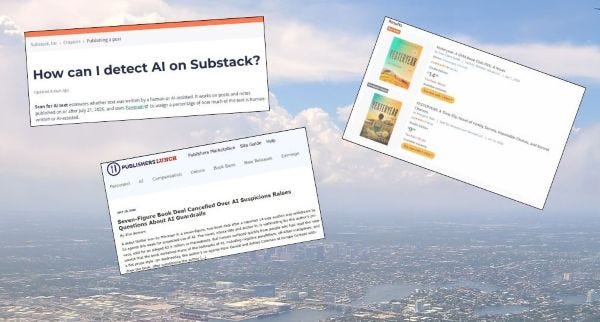
From witch hunts about authors with potentially AI-generated books garnering — and rapidly losing — huge book deals (not to mention their reputations), to actually AI-generated books duping readers into buying them via copycatting a human-written book, to Substack allowing readers run posts through an AI detection tool to determine if the Substacker used AI to write it…I mean, what’s next?
Seriously, what’s next?
What if we’re sick of it? Really, truly sick of it?
Look, I get it. We don’t want to think about it, much less talk about it anymore. Mostly because all we feel is outrage, which is hella distracting from what we’re supposed to be doing: namely, being authentic, creative human beings.
[As an aside, for many writers that means, among other things, using — you guessed it — em dashes. Ahem.]
But like a wreck on the highway, we can’t turn our eyes away. We’re left wondering how this one will be resolved, and what the next one will be, and how that one will be resolved, and how the hell are we going to get past (or will we get past) the environmental impacts?
And, on a personal note, how is this going to affect us? How will it affect our work? How will it affect our work finding its audience?
So what’s an author to do?
I can only speak for myself, but here’s how I counter those “sky is falling” feelings:
Connect with fellow authors. Join writers’ groups, attend book events, go to conferences. Become part of the conversation, because you’ll feel much less isolation and despair when you hang out with people who get it.
Find your people. That means readers, book clubs, librarians, booksellers, podcasters, members of the media, and anyone else who loves books. They’re out there, and they truly want to connect with actual authors.
Ask for reviews. This is something I shamelessly do. Most of us have trusted sources for book recommendations: friends, book clubs, neighbors — and, for many people, online reader reviews. In short, readers trust other readers. So when someone tells me they loved one of my books, I always ask them to leave a review online, if they’re so inclined.
Relish the writing process. I mean truly enjoy every moment of it. The anything-goes nature of the first draft. The refinement of subsequent drafts. The “this isn’t working” moments, followed by the “aha!” moments when you keep going, and you finally figure it out. The research rabbit holes that are so damn interesting and so much fun. Why skip any of that?
Take your time. I realize this isn’t an option if you’re on deadline from your publisher. But if you’re not (or to the best of your ability, if you are), let your story take all the time it needs. This can be a challenge when we compare ourselves to other writers — it seems the authors we admire always have a new book coming out. This can lead to self-doubt, and when that happens, the temptation to take shortcuts might arise. But the best writing happens on its own schedule — and from what I’ve observed in my career and that of others, the authors who are most satisfied let their process unfold in this organic way.
Authors, how do you tackle the AI giant? Or do you? Have you found a “middle ground” — and if so, what does that look like? Let us know your process and tips!
So what’s a reader to do?
Maybe you don’t want to channel your inner Toni Morrison. Maybe if there’s a book you want to read and it hasn’t been written yet, you don’t want to write it. That’s understandable; not everyone who loves books wants to write one.
But let’s put things in perspective. When Toni Morrison said, ““If there’s a book that you want to read, but it hasn’t been written yet, then you must write it,” the year was 1981. I tried to find out how many books were published in the U.S. that year, but that data doesn’t seem to exist. (If anyone has a source for that, let me know.)
Presumably, the number was nowhere near what it is today. In 2025, the number of International Standard Book Numbers (ISBNs) issued in the United States exceeded 4 million.1
With that many books available, how are you supposed to figure out what to read? And how can you ensure what you’re reading was written by an actual human being? (Unfortunately, bots can obtain ISBNs, too. All you need is a credit card and an email address.)
Here are some ideas:
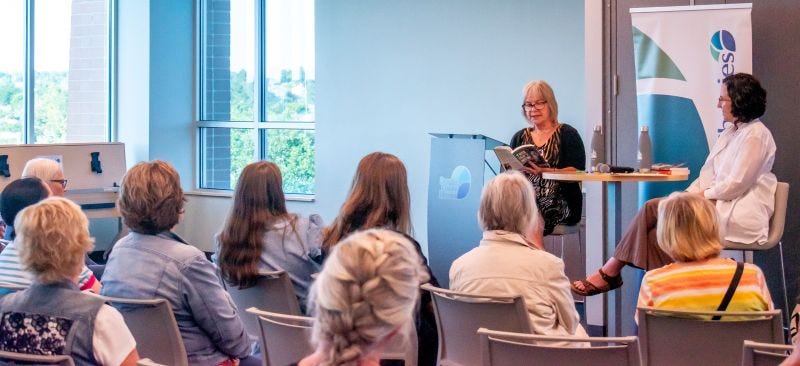
Connect with authors. If you can attend an author’s event, either in person or virtually, please do so. Follow authors on social media. Comment on their posts. It will become clear pretty quickly who’s real and who’s not.
Ask a human for recommendations. Librarians know everything, so start there. Or stop into your local indie bookstore and describe what you’re interested in — chances are, they’ll have a great suggestion for you.
Join a book club. Next month, my book club will celebrate 25 years together. Via my fellow book club members I’ve discovered countless amazing books in all kinds of genres — books I’d never have known about otherwise. Not sure where to find a book club? Again, start with that librarian or bookseller; they’re likely have ideas for you.
Write reviews. I can’t overstate this: readers trust other readers. Be part of the process by reviewing books you enjoy. Reviews don’t have to be long; just a sentence or two about why you liked the book is plenty. (I truly appreciate every review my books receive. If you’ve read This Isn’t New, review links are here. For Anyone But Her, they’re here.)
How do you find great reads? Please share with us!
Stay up there, sky.

There’s no question these are weird times, and the unknown can keep us up at night —if we let it. Focus on relationships, community, connection, and books by real, actual people.
If we all do this, I think we can keep the sky up there where it belongs.

https://www.publishersweekly.com/pw/by-topic/industry-news/publisher-news/article/99943-book-output-topped-4-million-in-2025.html
I can't dwell on AI. Won't read all the articles. Call it denial, ignorance, whatever, my focus stays on creating, and nothing shuts down my creativity more than fear. Life is filled with things that I can't control, but what I can control is my effort, my writing output, my reaching for the next word, the best word. And I, too, love em dashes--can't take that away from me!
I feel like you just thumbed your nose at AI and I LOVE IT! Let's just get on with it, shall we?